


AI for video localization: Key Takeaways
- AI has transformed video localization by enabling subtitles, dubbing, and voice-over to be produced faster and more scalable.
- In 2026, it is estimated that more YouTube creators will turn to fully automated channels.
- However, relying solely on AI for video localization is not enough. In practice, while complete automation will be quicker, human touch helps with understanding cultural nuances, emotional timing, and brand voice.
How AI Is Transforming Localization?
There was a time when localization was determined by cost, whether time or money; YouTube creators had to think of a specific cost to spend to make the video available to a varied audience. With AI for video localization, any YouTuber can access:
- Automatic translation of text between languages
- Speech to text ASR to transcribe audio
- Automatic timing and line segmentation
- Matching speech timing to on-screen movements
- Detecting and translating text embedded in video OCR
- Accessibility support with closed captions
The primary AI advantage is its speed and consistency. Before artificial intelligence, localization was slow and expensive, and quality was prioritized. But now, with greater consumption of views, creators want something that can meet demand quickly and at low cost.
The Limits of AI-Only Localization
The language is never the problem; it’s the use of technology. Here’s what most YouTube creators fail to realize:
- AI can translate words, but it cannot change their meaning based on context. Localization was never about simply translating a language; it’s more about reshaping words to reflect people’s understanding.
- The application of AI to video localization does have a strict meaning. Humar becomes literal, emotions and authority are detached.
- AI-only localization lacks accountability because the output is automated. Everyone understands the language but not the meaning.
Why Human Editing Matters in Effective Localization?
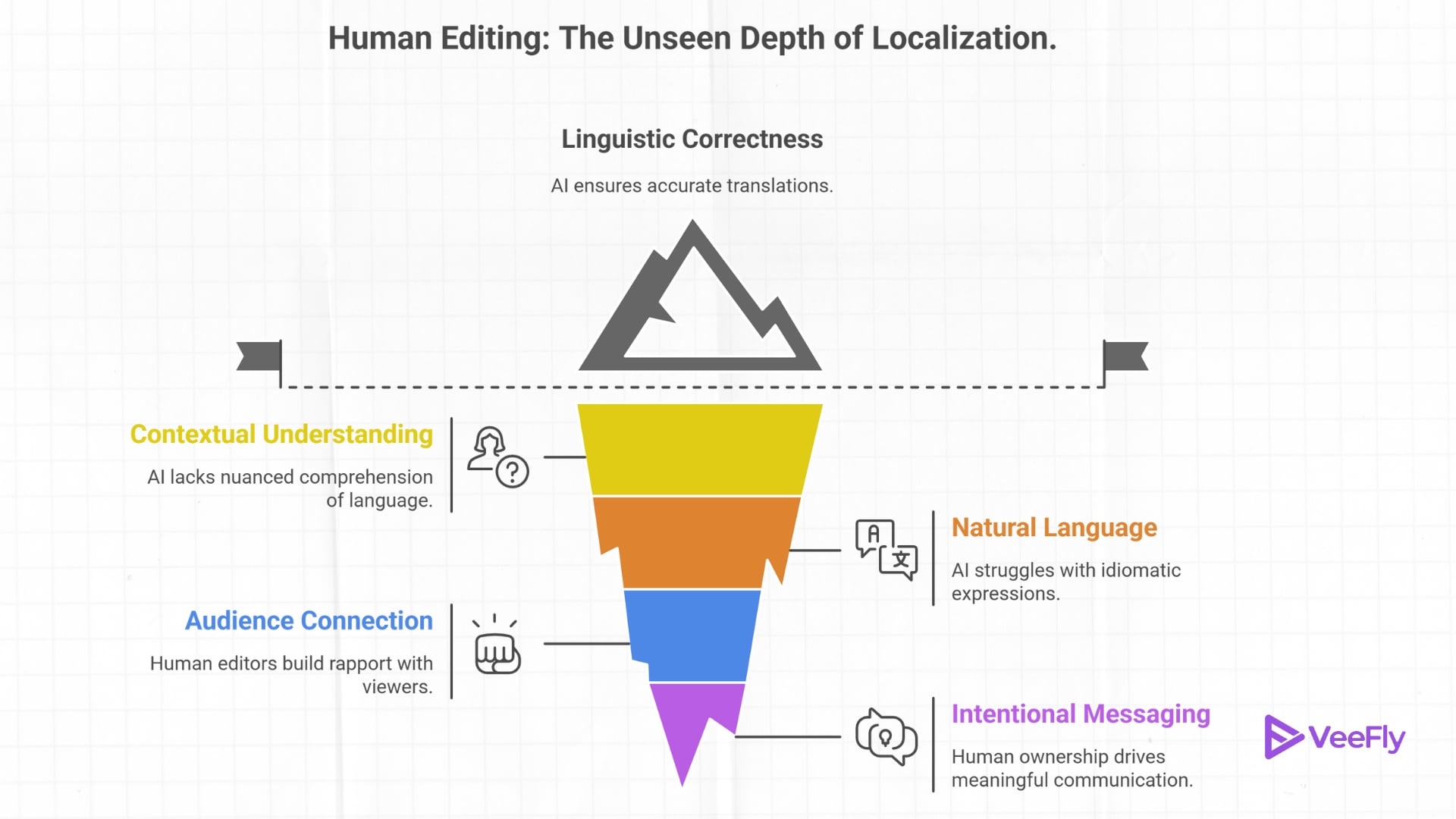
YouTube videos’ output can be linguistically correct but lack proper context. AI has no trouble handling scale, but it might struggle with natural language and audience understanding. YouTube videos will be produced; the capability never misses. But AI might not be able to make a proper judgment.
YouTubers revise scripts, have awkward pauses, and base their intuition on knowledge. Hence, the audience picks up on that and can relate to it. It’s safe to say that while AI can easily handle the scale, humans protect the meaning.
Human editors also have a responsibility to put out a message. The ownership forces YouTube creators to be more intentional about their work. Without a deliberate meaning, localization is merely a mechanical transfer rather than an act of communication.
Does AI for Video Localization Work Best With Human Touch?
While Artificial Intelligence can speed up video production, it’s the human touch that makes the video worth watching. Here’s how:
1)Incorporation of Experience and Accuracy
Since AI translates by default, human editors provide a search intent. As YouTube creators, you recognize what works where because of your experience uploading videos. Meanwhile, AI will ensure it provides accurate information for you helping you write pro YouTube scripts with well produced output.
2)Timing & Pacing Alongside Automation
Timing carries meaning; hence, YouTube creators can decide how to adjust pacing and which subtitles convey the message better. And AI mechanisms will make sure it’s correct, matching the rhythm.
3)Emotional Breaks in AI-Only Video Localization
YouTube creators sense emotional intent; hence, they can adjust their voice, sentence length, and delivery to match the meaning. Meanwhile, AI localization can help you produce content that viewers understand quickly.
4)Human Editors Decide the Right Transition
An AI workflow produces the output more quickly, so you can focus on making clear decisions with accountability. With a reliable partner, you can differentiate between what is acceptable and what is effective.
Conclusion
AI has permanently changed how YouTube video localization is done. While full automation can enhance speed and scale, it helps solve distribution problems, not communication ones. With AI, you can generate language, align audio, and multiply output. And human YouTube creators can provide intent and meaning. Hence, a hybrid system is the future of global YouTube localization.
Frequently Asked Questions
Q1)Will AI and Human Editing for Localization Work in 2026?
Yes, YouTube localization requires AI and YouTube creators working together to deliver fast, targeted output.
Q2)Can AI and human editing work together?
Yes, the hybrid model works best for the YouTube platform since both depend on each other to produce effective videos.
Q3)AI vs human editing in video localization scope in 2026?
Yes, by 2026, AI will handle subtleties, translation, and mechanics of localization, while human editors will be essential for creative decisions, emotional tone, and cultural adaptation.
Q4)Will AI replace YouTubers?
No, AI can assist in editing and voice generation, but it can’t yet replace human intent.
Q5)Is AI video localization allowed on YouTube?
Yes, YouTube allows AI-generated and AI-assisted localization, including subtitles, yet creators are responsible for transparency and ensuring content doesn’t mislead viewers.
