


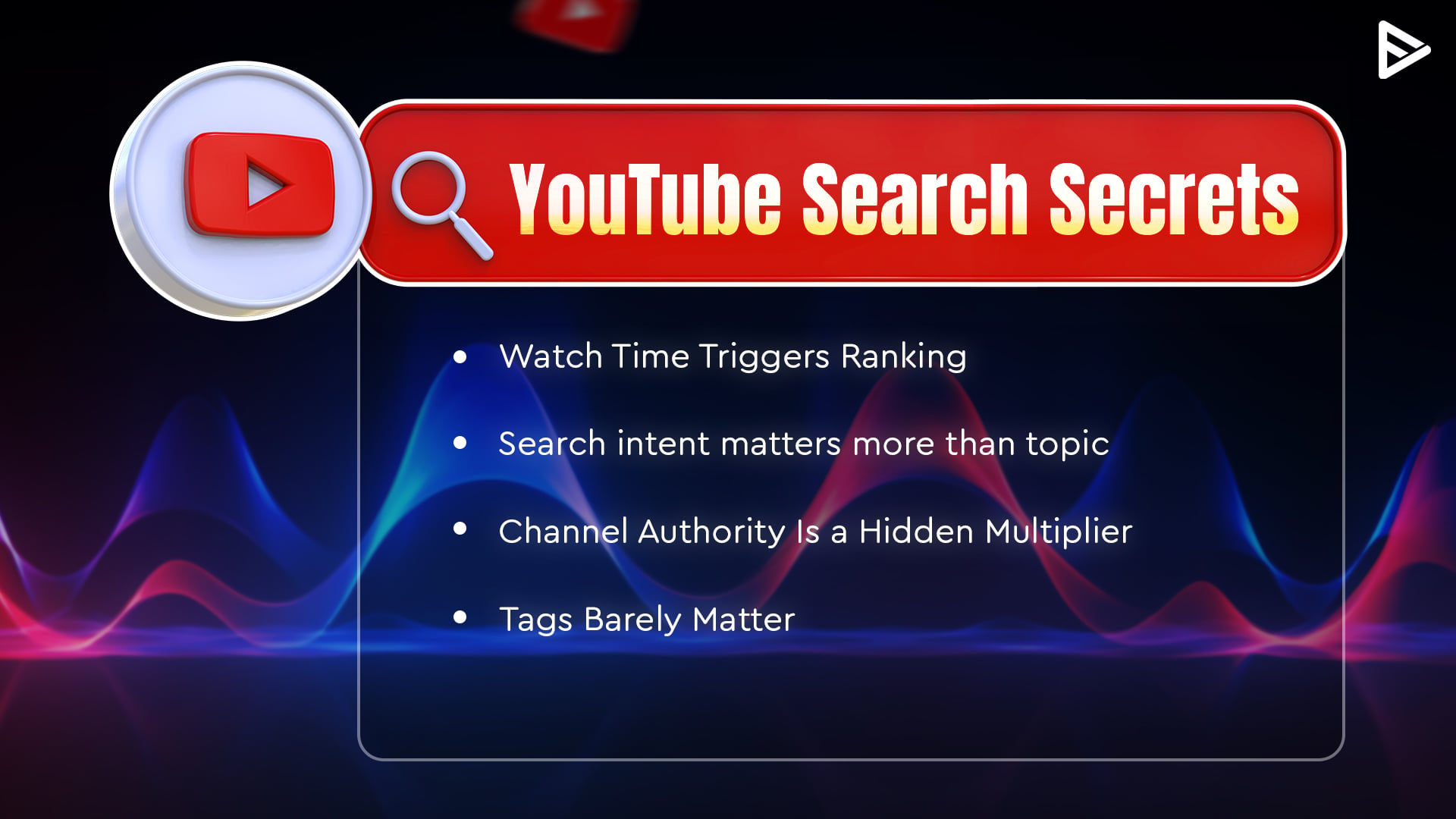
How Does YouTube Search Work: Key Takeaways
- Identify whether the query is informational, educational, or commercial to match the search intent.
- Aim for at least 50% average view duration. YouTube prioritizes videos that keep viewers watching over those with perfect keyword placement.
- YouTube videos that refresh their titles, thumbnails, and descriptions rank better.
How YouTube Understands Search Queries?
A large-scale machine learning system powers YouTube search. To rank on YouTube, you need to understand how the platform interprets what users type in the search bar. According to YouTube’s own documentation, search results are influenced by relevance to the query and key performance indicators such as engagement and watch time. Understanding how YouTube processes the search queries helps you align your content. Here’s what you should know:
1)Keyword Interpretation
The platform asks one primary question while deciphering it, ‘What is this user trying to find?’. Many creators assume YouTube is trying to match words. Still, in reality, it’s trying to solve user problems with the best search results.
Example: If someone looks for ‘How to grow on YouTube?’, the system will compare it to two videos titled, Video A: ’10 ways to build a subscriber base’ and Video B: ‘My honest feedback on YouTube’. Even if video B contains the same information about YouTube growth, the system will consider video A more relevant.
Creator Takeaway: YouTube should be able to detect context from the title and description as the platform needs strong topical signals to match videos to search queries.
2)Search Intent Identification
The same keyword can have multiple meanings and intentions. Hence, when YouTube detects the queries, it tries to see the intent behind them. Searches can be categorized into three types: informational, tutorial-based, and navigational. Each intent category has different behavioral expectations; that is, it can exhibit a high average view duration or a strong audience retention curve.
Example: If a user searches ‘What is the YouTube studio?’ YouTube will prioritize beginner-friendly breakdowns with clear meaning. It will not recommend case studies or advanced discussions. Similarly, if a user looks for ‘How to edit a photo on Canva?’, YouTube will show videos that are more action-oriented, with step-by-step instructions. Hence, videos titled ‘What is Canva?’ won’t be ranked.
Creator Takeaway: If your format doesn’t align with the intent, ranking becomes difficult, even if your keywords are correct.
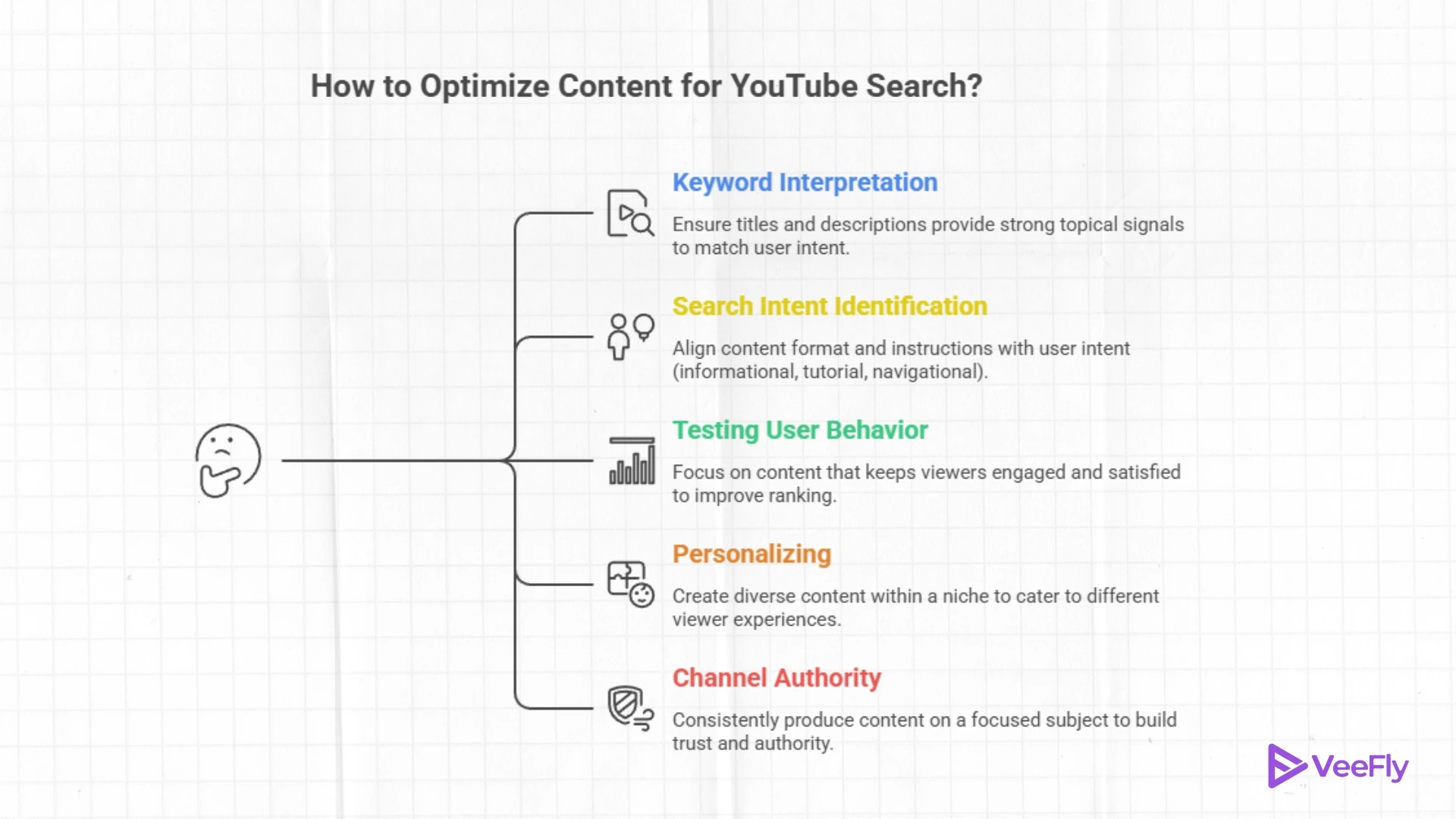
3)Testing User Behavior
Even though the platform tries its best to match the results, it still prefers to know how users interact with the answers.
Example: If a user searches ‘How to manage YouTube brand account?‘ varied video options will appear. Video A has a 20% click-through rate, with viewers watching 90% of the video. Further, most viewers stopped searching afterward. Meanwhile, Video B has a 5% click-through rate, viewers leave after 30 seconds, and many viewers return to the search bar. Clearly, YouTube A will conclude that the video is addressing the viewer’s intention and, as a result, rank higher in search engines.
Creator Takeaway: Matching the format and content to the intent is highly crucial for ranking well on YouTube.
4)Personalizing
Search results can be customized. Even if the same keyword is typed, the results can vary. The algorithm adjusts results based on past behavior.
Example: If two users are looking for ‘Improve YouTube SEO Strategy‘, the same keyword can yield different results based on their viewing history; hence, they can be recommended two different videos.
Creator Takeaway: YouTube tries to match content to viewers experience levels; hence, it’s important to create diverse content within the same niche.
5)Channel Authority
YouTube doesn’t recommend or evaluate videos in isolation. The platform also recommends videos based on your channel history.
Example: Within two channels, one focuses on YouTube growth, SEO, answers to queries like ‘how does YouTube search work’ and related tips. At the same time, other channels also feature vlogs or travel content. Channel 1 is more likely to rank well due to its topical authority.
Creator Takeaway: YouTube builds confidence in channels that consistently produce content on a focused subject.
Conclusion
Don’t mistake authoritative rankings for mere luck; they’re driven solely by viewer satisfaction. Before you produce a video, ask yourself whether the content will deliver what people are looking for. YouTube creators who struggle with search often focus solely on optimization, overlooking other equally important factors. Hence, the key learning is that search visibility isn’t about chasing the algorithm, but about earning trust through consistent, high-satisfaction content.
Frequently Asked Questions
Q1)How long does it take for a YouTube video to rank in search?
YouTube videos typically begin appearing in search results within a couple of hours; however, competitive rankings can take up to 90 days.
Q2)Are keywords still important for YouTube search?
Yes, keywords are important for YouTube search since they provide context to the algorithm. Furthermore, using keywords, YouTube can categorize videos more effectively.
Q3)How does the YouTube recommendation algorithm work
The YouTube algorithm is a user-centric, AI-powered system that personalizes content by predicting viewer preferences.
Q4)Can small YouTube channels rank in YouTube search?
Yes, small YouTube channels can rank in YouTube search by optimizing metadata, producing quality content, and targeting low-competition keywords.
Q5)How does the YouTube algorithm work for AI channels?
YouTube’s algorithm treats it like any other content category. Still, it closely examines viewer behavior to determine whether AI videos maintain strong retention and deliver value.
