


Key Takeaways
- YouTube introduces 5 updates, including Ask YouTube, AI Labels, teen parental control, and AI playlist.
- YouTube removes the clip feature, changing the course of long-form videos.
- Focus on 100% of your time on viewer satisfaction, and answer their user queries for the YouTube algorithm 2026.
- Avoid traditional SEO and follow the platform guidelines.
What Changed in YouTube’s Algorithm?
The YouTube algorithm influences 70% of a channel’s total watch time. Hence, taking into consideration how the system operates becomes a top priority in content creation. Earlier, YouTube prioritized watch time and engagement metrics; starting in 2026, it has begun backing creators who consistently focus on quality content.
Long gone are the days when basic SEO or a great idea on paper could get creators viral. It is estimated that YouTube processes 80 billion signals daily. Hence, the algorithm can’t be fooled by keyword stuffing or trending topics. Creators need to be aware of updates to stay in sync with the platform’s evolving needs.
Top 5 Updates That Changed YouTube’s Algorithm in 2026
It’s undeniable that the platform is not the same anymore, so we have curated a list of 5 updates for the YouTube algorithm change 2026 for good. It includes:
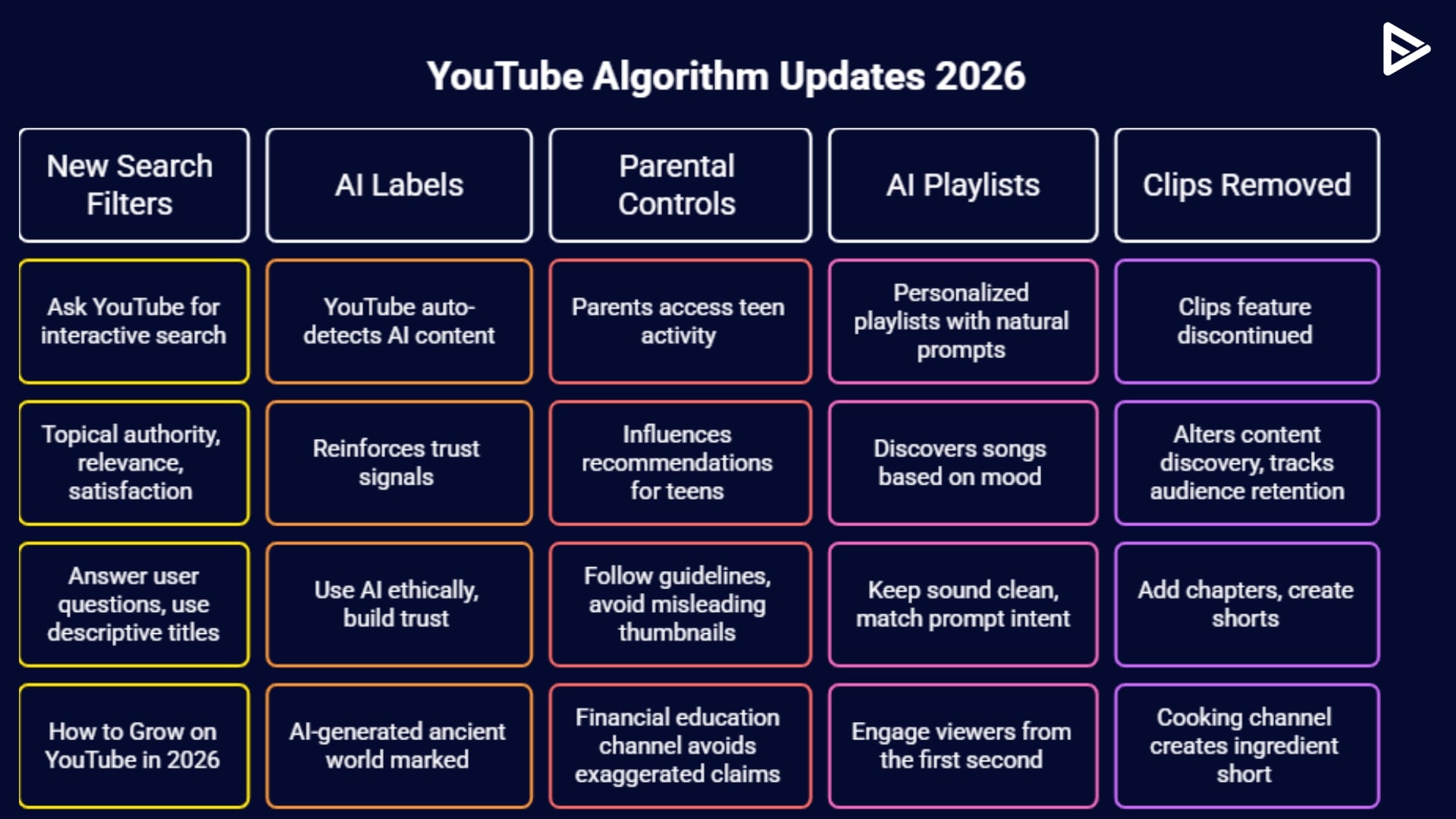
1)New Search Filters For Content Discovery
- What Changed: The introduction of Ask YouTube makes search results more interactive. Instead of typing short keywords like “Best Olivia Rodrigo Songs,” viewers can ask YouTube, “What are the best Olivia Rodrigo songs from the new album?“
- The Algorithm Impact: It’s one of the most massive updates. Previously, the ranking depended on exact keyword matches; now, topical authority, relevance, and viewer satisfaction are important to the algorithm.
- What Should Creators Do: Don’t focus only on traditional SEO; focus on answering user questions. Use descriptive chapter titles and video descriptions.
- Example: Instead of titling it “How to Grow on YouTube,” write “How to Grow on YouTube in 2026 with 10 Proven Strategies.“
2)Auto-Detecting AI Labels For Transparency
- What Changed: The platform expands automatic AI-generated content labels. Previously, creators were responsible for disclosing the use of AI in their videos; now YouTube flags it for viewers.
- The Algorithm Impact: Simply using AI won’t negatively affect your videos’ ranking. The update will reinforce trust signals to help the algorithm better sort videos.
- What Should Creators Do: For YouTube algorithm change, use ethically AI-generated videos and focus on building trust with the audience.
- Example: A history creator will use AI to build an ancient world because viewers could mistake it for authentic footage; YouTube will mark it as AI.
3)Parental Controls For Teen Viewing Habits
- What Changed: Parents can directly access teens’ YouTube activity and get more insights. Further, teens will receive well-being reminders and educational resources.
- The Algorithm Impact: It’s not a restriction on creativity, but the YouTube algorithm will influence the recommendations it shows teens. Creators whose demographics are teens might see changes in how their videos are distributed.
- What Should Creators Do: Follow YouTube guidelines and avoid misleading thumbnails to align with YouTube parental control update.
- Example: A channel focusing on financial education needs to steer clear of exaggerated claims.
4)YouTube AI Playlist For Better Insights
- What Changed: The audience can generate personalised YouTube AI playlists using natural prompts.
- The Algorithm Impact: Playlist creates an excellent opportunity for content discovery. Now, instead of manually typing keywords, viewers can simply ask YouTube for a 30-minute list of Joji songs, and the platform will start playing the singer’s videos automatically. The algorithm now discovers songs based on the mood of the uploaded audio rather than just keywords.
- What Should Creators Do: Keep the sound clean with a strong hook. Since AI listens to your uploaded video, make sure the prompt intent matches the content.
- Example: Instead of starting the song after 15 seconds, keep the viewers engaged from the first second.
5)YouTube Clips Removed For Redundancy
- What Changed: YouTube discontinued the clips feature that allowed users to create short clips from longer videos.
- The Algorithm Impact: How the audience discovers memorable moments is altered. It simplifies content sharing while reducing the overlap between shorts and clips. However, the algorithm can no longer be tricked by looping clips. It tracks behaviour, since with time stamps, the entire video is available to the viewer, the platform can see whether the audience watches the entire video or drops off. Hence, indirectly, YouTube Clips removal has become a key indicator of Audience retention.
- What Should Creators Do: For YouTube algorithm change, creators need to add structured chapters to their videos and create shorts from key moments.
- Example: A cooking channel can create a short clip of all the ingredients used in the video. It can be uploaded as bite-sized content.
Final Thoughts
In 2026, with AI taking over the platform, creators need to be mindful of how they are letting their videos interact with the algorithm. Features like AI-powered search and playlist generation are designed to improve content discovery. While YouTube algorithm change updates such as AI label and teen supervision reinforce YouTube’s commitment to viewer trust. For long-term growth, ensure you align with these changes.
Frequently Asked Questions
Q1) What is the biggest YouTube algorithm change in 2026?
One of the most significant updates is the introduction of Ask YouTube, an AI-powered search feature that understands user intent rather than relying solely on keywords. For creators, it changes how videos are discovered and encourages them to optimise content.
Q2)Does using AI content hurt your rankings?
No, YouTube does not penalise creators simply for using AI. However, low-quality, repetitive, or misleading AI-generated content may perform poorly or be subject to policy enforcement.
Q3) How do labels affect YouTube videos?
AI labels help viewers identify videos containing realistic synthetic or manipulated content.
Q4)Why did YouTube remove the clips feature?
YouTube removed Clips to simplify content sharing and focus on features like Shorts and timestamped links.
Q5)Can I adjust my YouTube algorithm?
Yes, you can train your algorithm and help your videos rank better.
