


Key Takeaways:
- Depending on your niche, audience quality, and average views, YouTube sponsorship rates can differ. It may range from under $100 for small creators to several thousand dollars for established channels.
- Most corporate media buyers rely on a basic long-form integration CPM of $15 to $80 to price individual sponsorship placements.
How YouTube Sponsorship Pricing Actually Works
Brands do not choose pricing models at random; they select the ones that align with their specific tracking indicators.
1. Flat-Fee Package: The brand and the video creator agree on a fixed price per video before production begins. This projection is calculated by analyzing the channel’s last 10 long-form uploads.
2. CPM: Under this, your final payout is tied directly to the actual volume of impressions your video delivers. If the video fails to hit traction, your payout drops; if it goes viral, so does your revenue.
3. Performance-Based: The sponsor pays a set Cost Per Acquisition (CPA) price for each verified sale.
4. Hybrid Revenue: The creator secures a guaranteed fee to cover their video production. The sponsor then offers cash bonuses for crossing the sponsored video milestones.
Average YouTube Sponsorship Rates in 2026
| Average Views per Video (90-Day Window) | Estimated Sponsorship Price Range | Typical Creator Tier Focus |
|
1,000 – 10,000
|
$50 – $500 | Emerging Creator |
|
10,000 – 50,000
|
$500 – $5,000 | Growing Creator |
|
50,000 – 100,000
|
$5,000 – $12,000 | Established Creator |
|
100,000 – 500,000
|
$12,000 – $25,000 | Professional Media Entity |
|
500,000+
|
$25,000 – $100,000+ | Enterprise Campaigns |
What Is YouTube Sponsorship CPM?
The metric driving sponsors is the Cost Per Mille, which represents the cost a sponsor is willing to pay for every 1,000 views of your content. This metric enables them to evaluate the financial efficiency of a YouTube creator partnership alongside alternative advertising options, such as Google Ads or Meta campaigns. The basic mathematical formula used to establish a CPM-based rate card is structured as follows:
Base Integration Fee = Average Views of Last 90 Days divided by 1000 multiplied by Market Niche CPM.
How YouTube Sponsorship Varies Across Niches
Analyze this breakdown of the standard 2026:
- B2B SaaS & Developer Tools ($40 – $80 CPM): The audience comprises enterprise founders, software engineers, and corporate buyers. Because the lifetime value of a single software subscription can reach tens of thousands of dollars, B2B brands are willing to pay premium prices for direct access to targeted users.
- Personal Finance & Investing ($30 – $60 CPM): Audiences are actively looking for investment apps, banking products, or credit tools. High disposable income means conversion traffic yields immediate returns for fintech sponsors.
- AI Tools & Productivity ($28 – $55 CPM): Emerging technology startups are aggressively deploying capital to capture market share, flooding productivity channels with expansive sponsor budgets.
- Tech Reviews & Hardware ($25 – $45 CPM): Consumer electronics brands often pair cash fees with premium hardware to support high-end production testing.
- Education & Self-Improvement ($20 – $40 CPM): Audiences are inherently looking for self-improvement tools, driving consistent sign-ups for course platforms and productivity apps.
- Gaming ($15 – $30 CPM): High volume, lower pricing leverage. While gaming view counts can scale exceptionally fast, the audience demographic often skews younger with lower immediate disposable income, keeping CPM metrics compressed.
- Lifestyle & Vlogging ($15 – $25 CPM): The lowest standard CPM tier due to broad audience intent. Viewers tune in for personal entertainment and human connection rather than explicit buying missions, requiring brands to focus on awareness over raw conversion.
YouTube Sponsorship Calculator
Do not rely on broken web generators to price your business deals. To build an unshakeable position during contract discussions, use this professional, multi-layered valuation formula to build a highly defensible YouTube sponsorship calculator configuration:
Total Sponsorship Value = Base Integration Fee + Production Labor + Usage Rights Premium + Exclusivity Protection
Step-by-Step Valuation
- Calculate the Base Integration Fee: Isolate your median view counts over your last 10 long-form uploads, divide that number by 1,000, and multiply the result by your industry’s average niche CPM.
- Layer on Production Labor Premiums: If a brand requests a dedicated video asset rather than a standard 60-second mid-roll mention, apply a flat production multiplier ranging from 2.5x to 4.0x to your baseline integration fee to compensate for the intensive scriptwriting, shooting, and staging labor required.
- Value the Paid Usage Rights: If a brand wants the contractual right to cut your video into short clips and run them as paid advertisements, you are acting as an ad agency. Charge an additional premium of 25%- 100% of the base fee, depending on the usage window.
- Account for Category Exclusivity Fees: If a sponsor demands that you refuse to feature any competing products on your channel for 60 days post-publish, they are blocking your pipeline to alternative revenue. Charge a premium of +25% to +50% to cover the loss of potential income from industry competitors.
10 Factors That Affect Sponsorship Pricing
To accurately evaluate how much to charge for YouTube sponsorship deals, you must look past simple view counters and consider these factors:
- Average 90-Day Trend: The primary benchmark indicator used by agencies. This metric measures your recent content health.
- Audience Geographic Density: Channels with over 60% of their views originating from Tier 1 regions command triple the pricing power of profiles tracking traffic in lower-income ad regions.
- Comment Engagement Sentiment: An active comment section indicates high community trust, signaling to a brand manager that your recommendations carry weight.
- Vertical Market Density: If your channel sits inside a highly specialized micro-niche with very few macro competitors, your scarce audience access points command a premium pricing card.
- Average Video Retention Stability: A stable retention curve proves that your editing style holds attention through the midpoint of your timeline, ensuring the audience actually sees the sponsor’s integration.
- Asset Production Complexity: Heavy 3D animation, deep research scripting, or dangerous on-location tracking layers justify a higher structural production overhead fee.
- Integration Location: Placements built within the first 60 seconds capture viewers at peak attention but may lead to lower engagement. Further, mid-roll spots integrated smoothly into your core narrative timeline command premium rates.
- Temporal Licensing and Usage Rights: Allowing a brand to download, allow, or repurpose your creative likeness across their corporate marketing channels requires an explicit premium surcharge.
- Competitive Category Exclusivity: Locking your channel out from partnering with alternative brands within your market vertical requires significant financial compensation.
- Total Multi-Video Deal Commits: Brands expect a performance discount of 20% to 30% if they contractually commit to a long-term, multi-video package bundle rather than a single trial upload.
How Much Should You Charge for a YouTube Sponsorship?
Setting your fee parameters requires clear alignment with your actual creator stage. Use these for upcoming negotiation discussions:
- The Nano / Emerging Stage (1,000 – 10,000 Subscribers): If your average views hover around 2,000, price your mid-roll integrations at a flat $100-$250. Do not turn down deals simply because the cash is low; focus on securing free premium products, tracking high click-through conversion data, and earning professional testimonials you can feature in your upcoming pitch decks.
- The Growing Creator Stage (10,000 – 50,000 Subscribers): If your content maintains a steady baseline of 15,000 views in a mid-tier niche like productivity, your minimum integration rate should sit between $1,200 to $2,500. Open your negotiations 30% above your baseline minimum to leave comfortable room for back-and-forth compromise without undercutting your margin floor.
- The Established Media Stage (50,000+ Subscribers): If your channel maintains a view count of 60,000 in high-value business sectors, your baseline integration starts at $4,000-$6,500, while a fully dedicated asset scales to over $10,000. Never display these public rates on your website or in your video descriptions. Once a price card is public, it serves as a hard ceiling, preventing corporate buyers from offering more, even if they have larger available budgets.
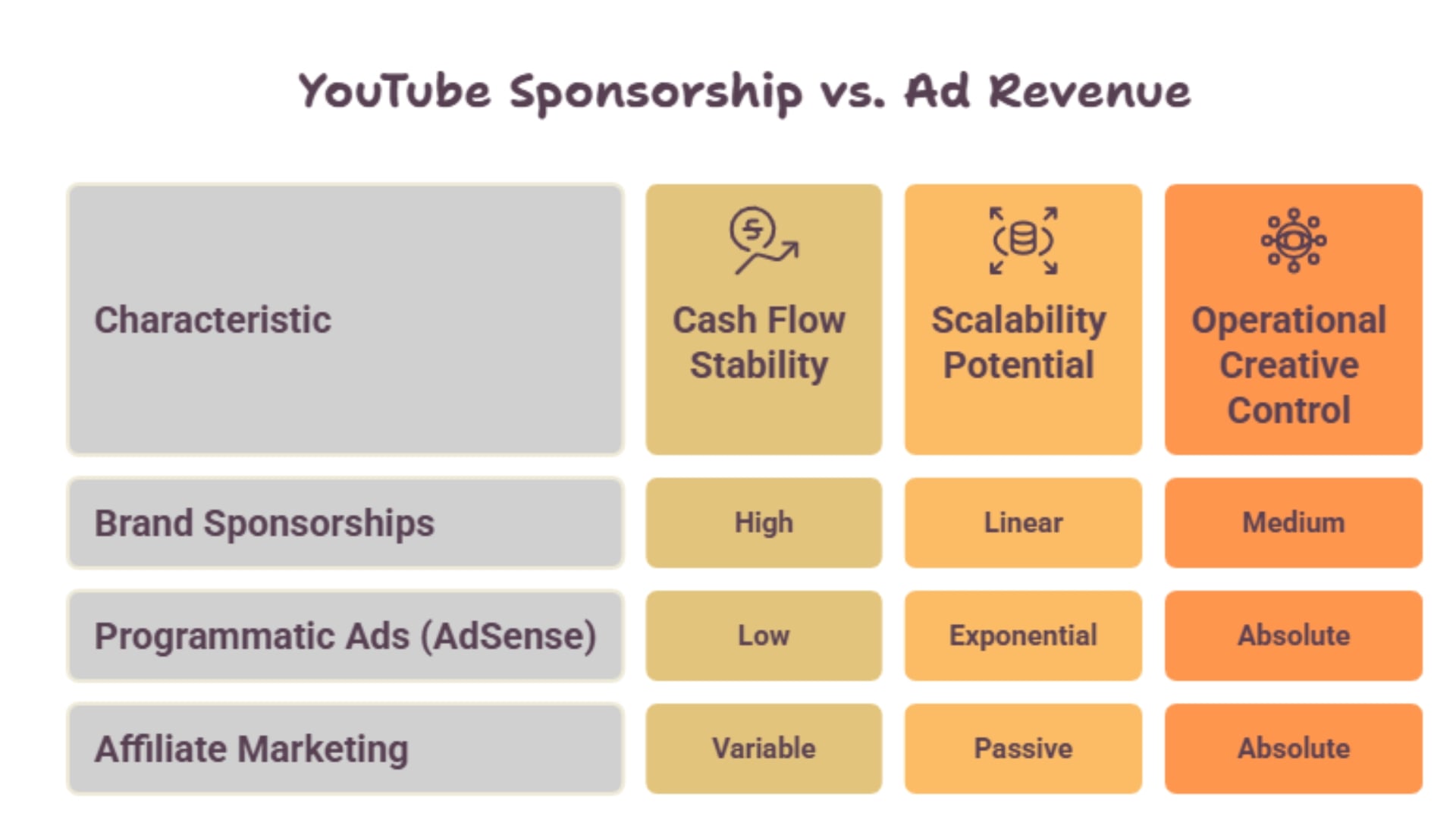
YouTube Sponsorship vs. Ad Revenue: Which Pays Better?
Biggest Pricing Mistakes YouTube Creators Make
- Pricing Content Strictly by Subscriber Metrics: Falling into the trap of using formulas like “$20 per 1,000 subscribers.” Further, this outdated mindset leads to massive overpricing on dead accounts or massive underpricing on lean channels with high view velocity.
- Giving Away Commercial Usage Rights for Free: Allowing a multi-billion dollar corporate entity to use your face and video files as a paid social media advertisement indefinitely without collecting a recurring licensing premium.
- Failing to Limit Production Revision Rounds: Brands can trap you in endless feedback loops, demanding four completely separate video re-shoots without paying additional compensation. Limit your agreements to a single round of minor structural revisions.
- Ignoring Long-Term Exclusivity Clauses: Agreeing to a broad contract clause that prevents you from working with any food, beverage, or lifestyle brand for six months, completely locking up your channel’s future earning power for a tiny upfront payment.
How to Increase Your YouTube Sponsorship Value?
To systematically force corporate brands to pay premium multiple rates for your content integrations, here’s what you can do:
- Your media kit should operate as a high-end corporate pitch deck. Eliminate amateur design and build a clean, scannable layout that highlights your 90-day average view count, your exact
- Tier 1 demographic distributions, your YouTube engagement rates, and verified case studies detailing how a previous sponsor achieved high conversion rates on your timeline.
- Explicitly state the format, e.g. one 60-second mid-roll integration and the exact upload timeline.
- Contractually limit the sponsor to a maximum of one round of minor structural edits.
- Ensure the exclusivity ban applies only to micro-niche direct product competitors, not an entire broad industry vertical.
- Lock down paid ad usage permissions to a set window rather than signing away permanent rights.
- Mandate a Net-30 payment structure backed by clear penalties for late payments.
- To ensure your audience stays locked onto the screen through the midpoint of your timeline. Additionally where the sponsor’s message sits, refine your storytelling structure.
- Implement high-contrast visual pattern interrupts every 3 seconds, use kinetic typography. At last design seamless narrative transitions to prevent sudden dips in your average percentage viewed.
Final Thoughts
There isn’t one universal sponsorship rate; pricing depends on multiple variables that measure real human attention and market utility. Stop underselling your hard work with outdated pricing sheets or vanity subscriber counts. When you pair high-retention visual storytelling with a data-driven understanding of your market value, you build an automated channel business. In the end it commands elite corporate partnerships for long-term, scalable growth.
Frequently Asked Questions
Q1. How much does a YouTube sponsorship cost for a brand?
A sponsored video typically costs anywhere from $500 per video for small, growing micro-channels to over $50,000+ per asset for large macro-influencers. Further, The final invoice pricing is calculated by analyzing the creator’s 90-day average view velocity. Then, applying a specific industry CPM multiplier.
Q2. What is a good YouTube sponsorship rate?
A fair baseline rate is calculated by matching your 90-day view count against an industry-standard long-form integration CPM of $15 to $80.
Q3. How is YouTube sponsorship pricing calculated?
Sponsorship pricing is calculated using a data-driven formula: your recent YouTube average view count. Moreover, it is divided by 1,000 and multiplied by your vertical’s target CPM.
Q4. How much does it cost to sponsor a YouTube video in a finance niche?
Finance and personal investing content commands the highest pricing metrics on the platform. It ranges from $30 to over $ 100 CPM on elite channels.
Q5. Does a channel with low subscribers have sponsorship value?
Yes, modern brand managers prioritize hyper-focused niche density, high comment engagement sentiment, and clear view velocity over raw subscriber metrics.
