


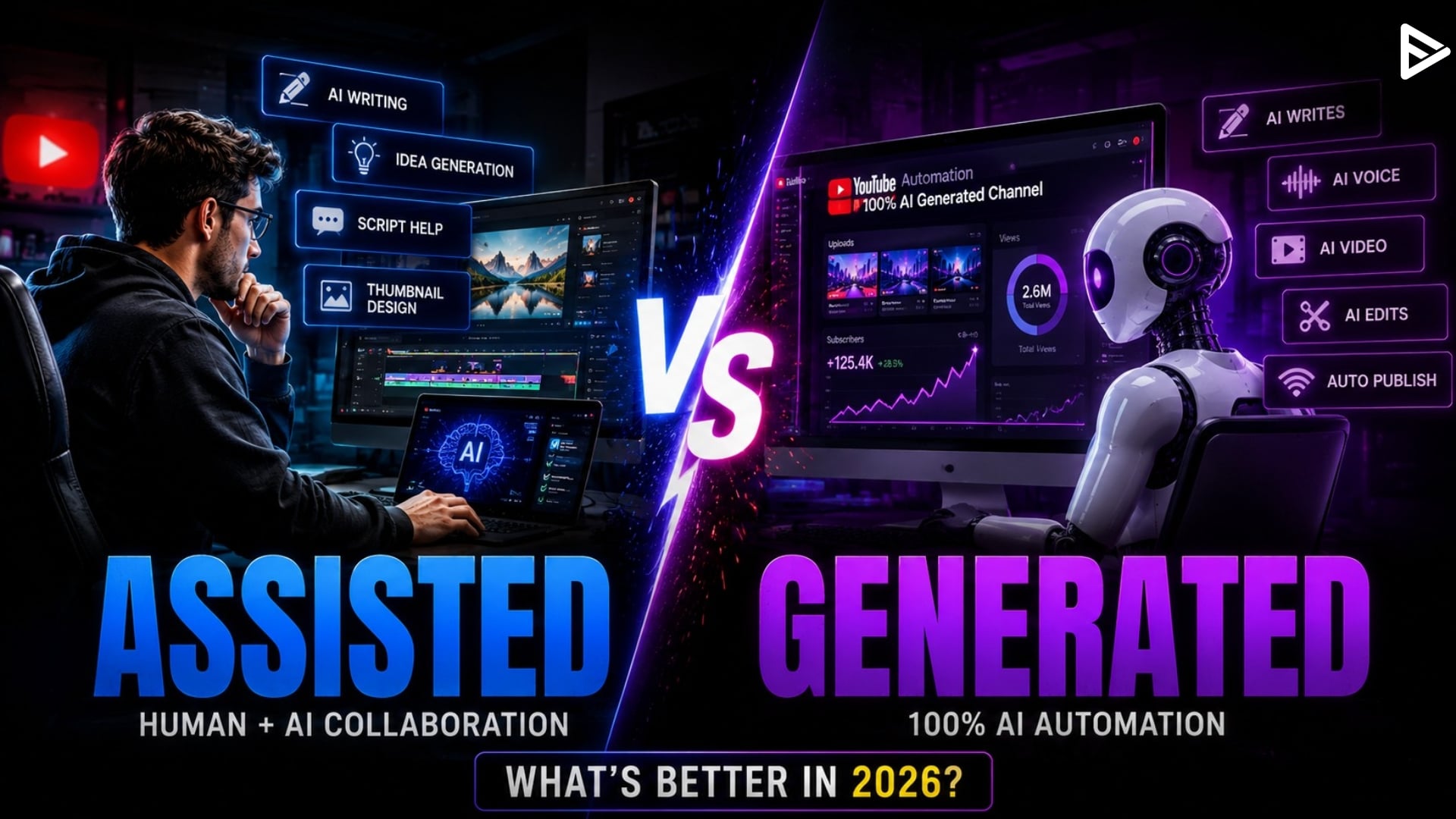
Key Takeaways:
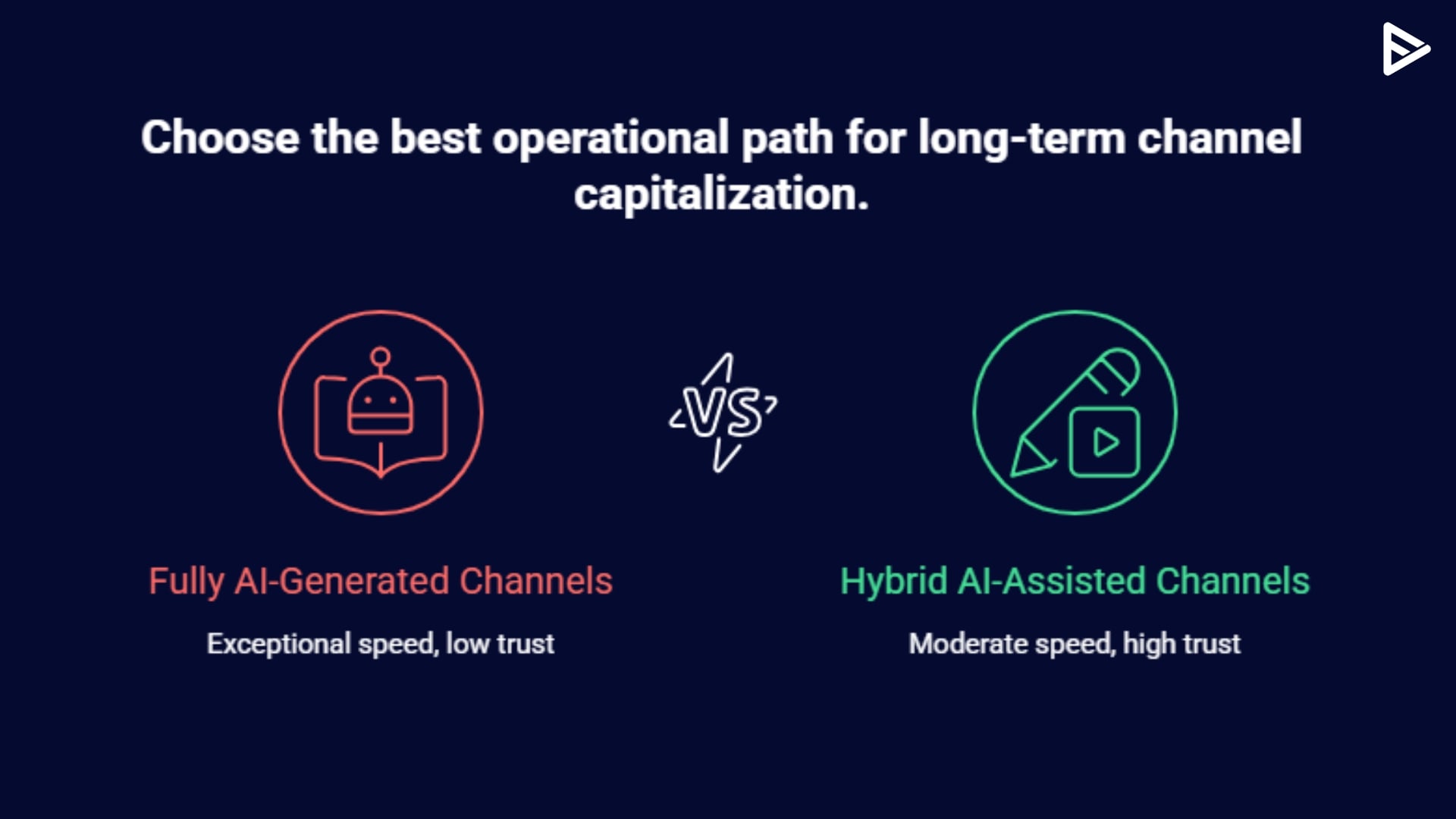
- AI-assisted channels produce stronger long-term engagement and watch time because human creators still control the core storytelling and audience connection.
- Fully AI-generated channels can publish content at a much higher frequency, however they struggle to build returning viewer loyalty due to repetitive pacing, synthetic voices, and an absence of a distinct creative point of view.
- We are witnessing the emergence of a definitive new YouTube format. This format is not defined by a specific video resolution, a new editing trend, or a vertical aspect ratio.
- Instead, it is an entirely new operational philosophy, a unified model in which advanced machine learning engines amplify, rather than replace, human ingenuity.
- To thrive in modern feeds, you must look beyond the binary question of whether automation is inherently good or bad. Instead, analyze it through a lens of raw data optimization.
AI-Assisted vs Fully AI-Generated: What’s the Difference?
Whereas for entirely prompt-driven; text is generated by large language models with zero human editing. Automated cloud software compiles stock clips, transitions, and overlays based on keyword matching. Standard synthetic voice generation models; uniform cadence with limited emotional variance. Moreover, purely programmatic; the workflow is driven by algorithmic loops and automated templates.
What Does YouTube Actually Reward?
- Initial Click-Through Rate (CTR): Does your visual packaging force a passing scroller to halt their thumb and click?
- Average Percentage Viewed (APV): How long can your timeline hold the user’s attention before they click away?
- Returning Viewers: Do users who watch your content return to your channel page when your next upload drops?
- Explicit Satisfaction Metrics: Post-video user surveys, share rates, likes, and comment depth.
Where AI Improves YouTube Content Creation
- Language models can scan massive text databases, synthesize complex whitepapers, and isolate compelling historical anomalies to provide raw creative material for your next script in seconds.
- AI can take a loose, unstructured concept and instantly organize it into a proven three-act storytelling structure with explicit hook vectors and climax markers.
- Graphic engines can instantly generate multiple color options, remove busy photo backdrops, or isolate high-contrast subjects to speed up your A/B testing loop.
- Machine learning models transcribe spoken dialogue with near-perfect accuracy, generating dynamic, word-by-word kinetic captions that keep silent mobile browsers locked onto your screen.
- Advanced translation networks can take your primary audio track and automatically revoice it into dozens of international languages while matching your original vocal tone, instantly expanding your geographic reach.
- Intelligent timeline software can automatically clip dead air pauses, remove repetitive filler words, and track objects across a 9:16 vertical frame, saving hours of manual editing labor.
Where Fully AI-Generated YouTube Channels Often Struggle
1. Repetitive Storytelling: Fully AI generated YouTube videos text systems predict the next word based on historical statistical probabilities, their default scripts favor safe, uniform sentence structures. They lack the ability to craft genuine narrative subversion, leading to uninspired content that feels identical to thousands of other automated uploads across the web.
2. Monotonous Pacing: Automated editing platforms match video clips to voice tracks based on simple keyword flags. This programmatic matching lacks emotional intelligence. The software cannot feel when a dramatic statement needs a silent, two-second visual pause to let the concept sink in with the audience, resulting in a flat, exhausting viewing experience.
3. Weak Early Emotional Hooks: Winning the initial seed audience test requires an immediate YouTube pattern interrupt technique. Automated templates often open videos with generic stock imagery of a city skyline or a person typing on a laptop, paired with boilerplate introductions. These low-stimulus openings drive immediate viewer drop-offs within the first three seconds.
4. Severe Attrition in Audience Trust: Human beings are inherently social creatures; they seek real connection, shared vulnerability, and reliable authority. When a viewer realizes they are listening to an unvetted synthetic script laid over recycled stock reels, the psychological contract of trust dissolves, preventing casual viewers from ever converting into dedicated, returning subscribers.
5. Human Creativity Still Matters: A human creator can look directly into a camera lens, share an unexpected personal failure, and instantly make a viewer feel understood. Human judgment controls the subtle art of creative timing, knowing when to break a conventional rule and how to structure a story so it impacts a real audience’s lifestyle decisions.
What This Means for New Creators?
The Educational / Video Essay Channel
- The Strategy: High Human + Medium AI.
- The Execution: Use advanced data tools to scan research papers and structure initial timeline outlines. However, the final script must be drafted by hand to verify factual integrity and to inject a distinct narrative style. Utilize human voice delivery to preserve domain authority and build long-term trust.
The Gaming Channel
- The Strategy: Medium Human + High AI.
- The Execution: Deploy automated asset-capturing software to flag and trim peak gameplay highlights or funny stream clips automatically. Use AI caption generators to overlay colorful, fast-moving kinetic typography across the vertical frame, while keeping the live webcam reactions and commentary 100% human-driven.
The Turnkey Faceless Information Channel
- The Strategy: Low Human + High AI.
- The Execution: Safe execution in this space requires building a robust, human-vetted automated factory. Use AI models to compile initial data frameworks, but retain a human editor to review every automated video render before publication. Swap out generic stock voices for premium, hyper-realistic custom cloned voice assets to protect your baseline user experience from sounding robotic.
