


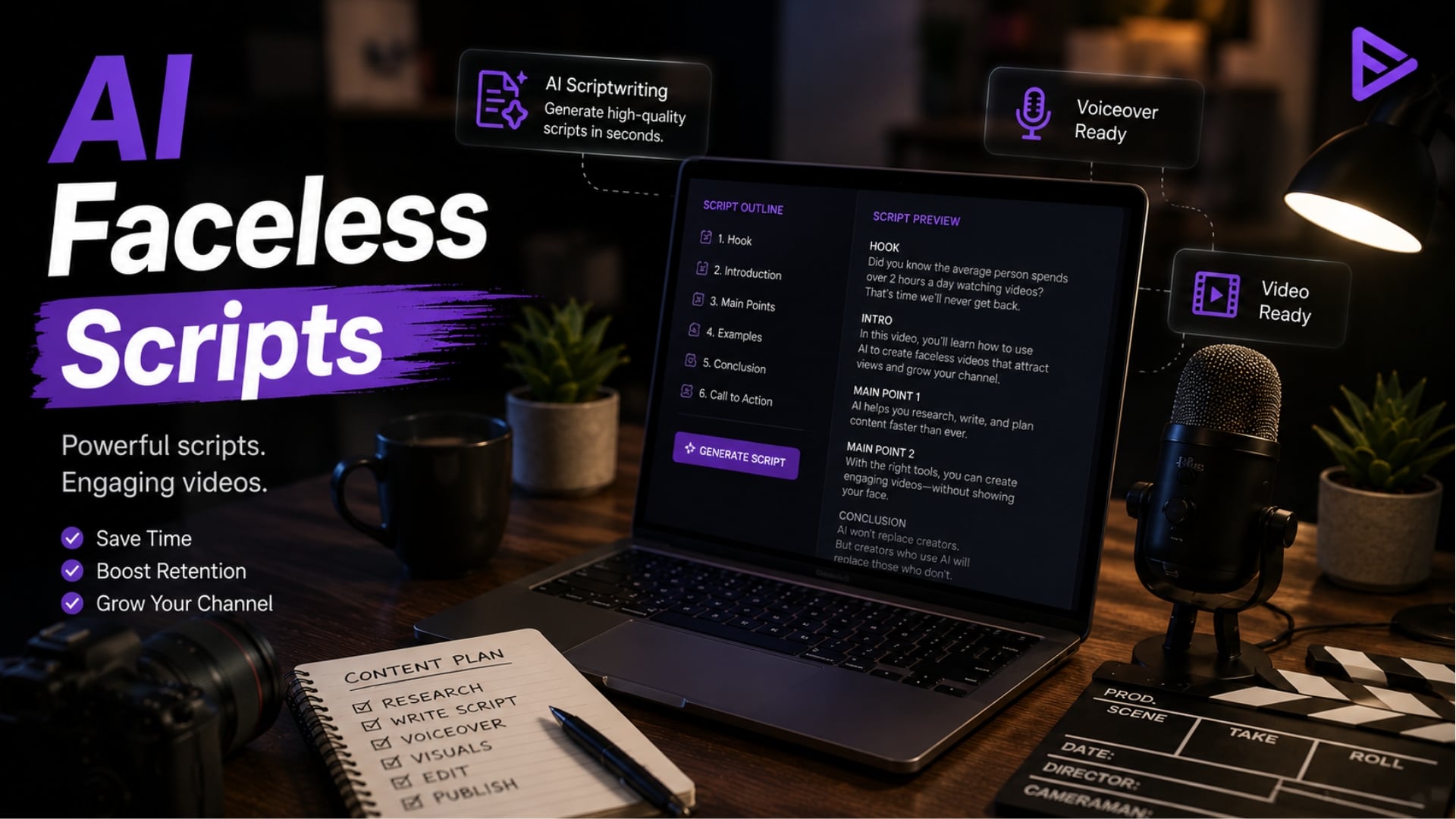
Key Takeaways:
- A faceless YouTube script relies on strong storytelling, as it shapes the entire video experience.
- Begin with a strong hook, show clear value, and use a structure that keeps viewers interested.
- A good faceless video script balances information, emotion, visuals, and pacing.
- Editing your script to keep viewers watching is more important than just making it longer.
What Makes a Good Faceless YouTube Script?
A faceless video script has one main job: keeping viewers’ attention without anyone on screen. A good script for a faceless YT channel usually includes:
- Hook: Grab attention instantly.
- Introduction: Tell viewers why they should keep watching.
- Main Story: Deliver value in a clear, engaging way.
- Transitions: Keep the content flowing naturally.
- Ending: End with a key takeaway and a call to action.
One of the biggest mistakes is starting too slowly. Viewers quickly decide if a video is worth their time. Rather than saying “Welcome back to the channel,” try opening with a question, a surprising fact, a conflict, or a promise. For example: Weak opening: “Today, we are going to talk about the history of smartphones.”
Better opening: “Twenty years ago, the phone in your pocket would have looked impossible. So how did we get here?” The second example gives viewers a reason to keep watching.
How to Write a Script for a Faceless YouTube Video?
Writing a faceless YouTube script is easier if you follow a simple process each time.
1. Start With Research and a Clear Angle
Before you start writing, think about what you want viewers to get from your video. Having a topic isn’t enough. Your script should have a unique angle.
Instead of: “Facts about space,” Try: “Why astronauts age differently in space.” A clear angle helps you come up with a better title, stronger visuals, and a more interesting story.
2. Create a Hook That Builds Curiosity
The first 15 to 30 seconds are the most important. Your opening should answer what viewers are wondering:
“Why should I watch this?”
Effective hooks include:
- A surprising discovery
- A problem viewers recognise
- A mystery
- A bold statement
- A story beginning
Don’t give everything away at the start. Focus on making viewers curious.
3. Build a Simple Script Structure
Most successful faceless videos use a clear structure: Hook → Context → Main Points → Examples → Conclusion. The middle of your script shouldn’t just list facts. It should feel like you’re taking viewers on a journey. Use transitions such as: “However, there is another side to this…” “But the biggest challenge came next…” “This changed everything…” These small moments help keep viewers interested in your video.
4. Write for Voiceover, Not Reading
A common mistake is writing scripts that look good on paper but sound awkward when spoken.
Read your script aloud. If a sentence sounds too formal or complicated, change it.
Instead of: “Technological advancement has significantly transformed communication methods.”
Use: “Technology completely changed the way people communicate.” Simple language feels more natural and helps viewers stay engaged.
5. Add Visual Direction
Faceless videos rely a lot on visuals. Your script should make it clear to the editor what should appear on screen. Example:Voiceover: “The company almost failed before becoming one of the biggest brands in the world.” Visual: Old company photos, timeline animation, and newspaper headlines.
This speeds up production and helps tell a better story.
Common Mistakes in Faceless Video Scriptwriting
Many creators focus on making longer videos rather than better ones. Here are common problems:
- Too much information: A script that’s just facts can get boring. Viewers want a story, not a textbook.
- Weak openings: If your opening lines don’t grab attention, people stop watching.
- No emotional connection: Even educational videos need emotions like curiosity, surprise, excitement, or tension.
- Writing without the audience in mind: Always ask yourself, “Why would someone care about this?”
Final Thoughts
A great faceless YouTube script is more than just a bunch of sentences. It’s the base for your whole video. Top creators know that viewers stay for the story, not just the format. Whether you use animation, stock footage, AI visuals, or voiceovers, your script should have a clear purpose, good pacing, and a reason for people to keep watching. Begin with a strong hook, write as if you’re talking to one person, and edit every line to keep viewers interested. That’s how you turn simple ideas into engaging faceless videos.
Frequently Asked Questions
Q1. How long should a faceless YouTube script be?
The length depends on what you want your video to do. A 5- to 10-minute video typically requires about 700 to 1,500 words, but keeping viewers engaged is more important than word count.
Q2. Can I start a faceless YouTube channel without writing scripts?
You can, but having a script usually makes your videos more consistent, better paced, and helps keep viewers watching. A clear script also helps you organise your ideas before you record or edit.
Q3. What topics work well for faceless YouTube videos?
Popular topics include education, history, technology, finance, storytelling, documentaries, tutorials, and entertainment. The best topic is one where you can regularly share valuable and interesting content.
Q4. How do I make my faceless YouTube script more engaging?
Use openings that spark curiosity, add storytelling, include examples, use smooth transitions, and cut out anything unnecessary. Every part of your script should give viewers a reason to keep watching.
