



Key Takeaways:
- Actively scan your niche weekly to identify videos that deviate significantly from baseline view averages.
- Audit the precise visual framing, title syntax, and opening 3-second pacing choices that forced the user’s click.
- Use language models to group cross-channel data, identifying exactly which keyword clusters hold the highest view velocity.
- Mine active viewer comment feeds to extract unfulfilled questions, objections, or feature demands that your competitors completely ignored.
- Use advanced writing assistants to sharpen your opening hooks, streamline script pacing, and inject high-contrast storytelling layers.
- Check current market upload density to verify you are entering a fresh, rising opportunity wave rather than an overcrowded trend.
- Continuously feed your post-upload analytics data straight back into your model systems to iteratively sharpen your channel’s future predictive accuracy.
What Is an Outlier Video?
An outlier video is an upload that achieves a view count significantly higher than the channel’s previous history. It represents an instance where the intrinsic value, visual packaging, and topical appeal of the individual asset completely overpowered the creator’s existing subscriber limitations.
When you ask a tool to come up with an original topic from scratch, it defaults to the most statistically average answer, leading to unoriginal scripts that bore modern audiences. AI is most effective when analyzing patterns across successful videos rather than generating ideas from scratch.
10 Ways to Find Outlier Video Ideas with AI
Apply these ten advanced strategies to discover how to find outlier video ideas with AI before your competition saturates the market:
1. Isolate Videos That Outperformed Their Channel Average
Use advanced platform indexing tools to rank video performance by an explicit outlier score. Calculate this by measuring how many standard deviations an upload falls from the creator’s trailing 10-video median baseline.
- Actionable Tip: Look for videos with an outlier score of 5x to 10x. If a channel normally pulls 2,000 views but an asset crosses 20,000 views, note it down immediately.
- Common Mistake: Comparing independent, niche videos directly against massive global channels. Replicating an enterprise-level budgeting concept rarely translates to an emerging channel.
2. Instruct AI to Extract Structural Pacing Patterns
Once you collect a dataset of three to four niche outliers, copy their full-text transcripts and paste them into your language assistant workspace. Use a highly specific prompt to force the AI to break down the dialogue’s architectural components.
- Actionable Tip: Use this prompt: “Analyze these four video transcripts from my niche. Dissect their structural formatting. Isolate the precise phrasing used in the initial 15-second hooks, map out where they pivot into secondary subtopics, and identify any recurring emotional triggers.”
- Common Mistake: Simply reading the text for a high-level summary. You need the AI to reveal the exact structural timeline rules that held user retention.
3. Analyze Competitors’ Outliers Instead of Their Recent Uploads
Many creators engage in low-value YouTube competitor research by copying whatever their largest rival published last week. This is an operational gamble; a large creator’s recent video might be performing poorly in terms of retention but is surviving purely on historical channel authority.
- Actionable Tip: Sort your competitor’s channel library or use an outlier tool layer to isolate their all-time top performers. Analyze the assets that continue to drive passive views months after publishing.
- Common Mistake: Assuming every high-view upload is a repeatable topic opportunity. If a video did well because it featured a unique celebrity guest, the outlier driver is the person, not the concept.
4. Mine Video Comment Sections for Unanswered Content Gaps
The comment sections of niche outlier videos represent an open repository of unfulfilled audience desires. When a video explodes in traffic, thousands of fresh viewers flood the comments to post follow-up questions, express technical confusion, or challenge the creator’s primary argument.
- Actionable Tip: Use browser extraction tools to scrape the top 200 comments from an outlier video.
- Common Mistake: Spending hours manually reading comments one by one. Let automation handle the parsing loop so you can focus entirely on your script structure.
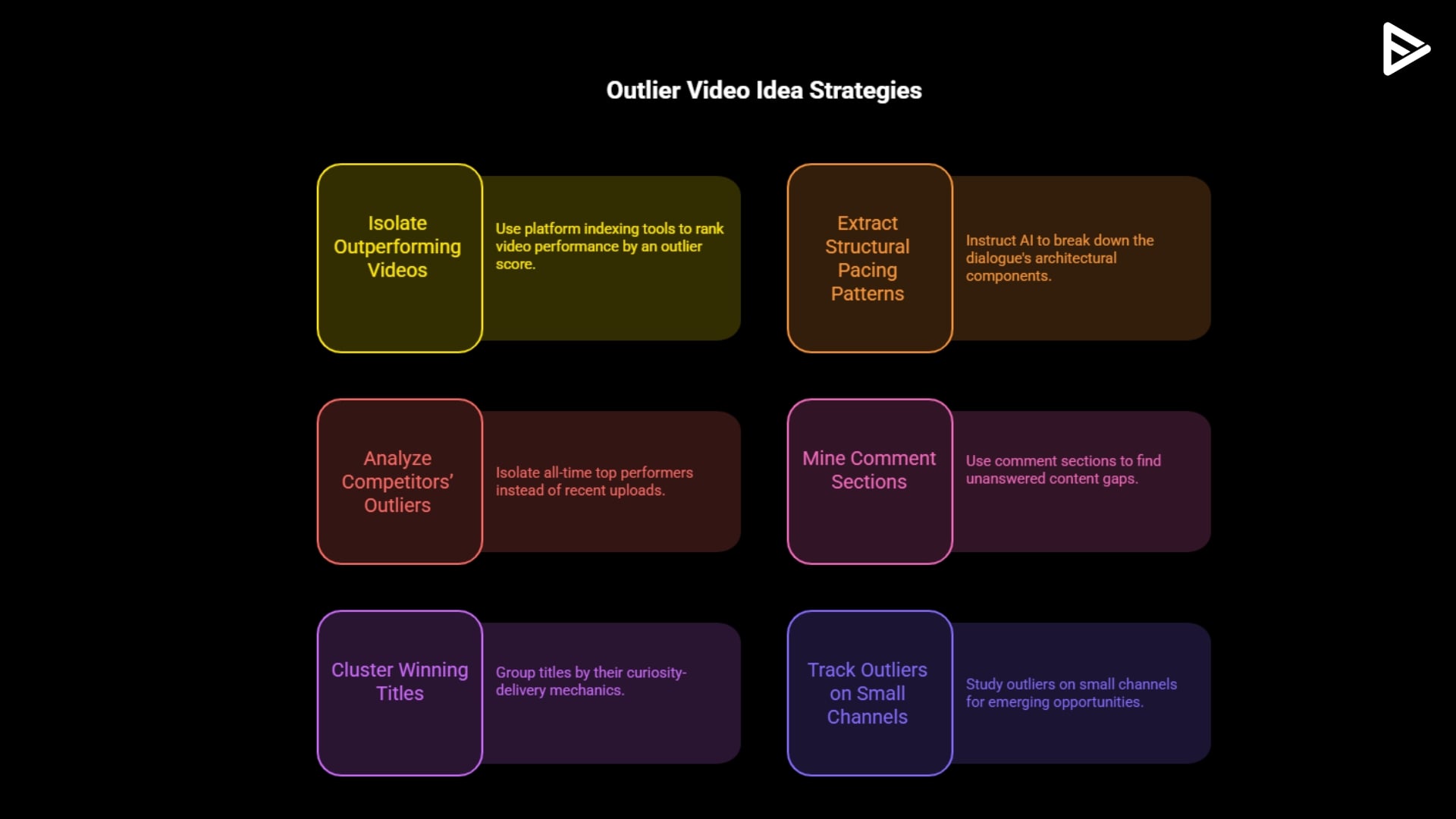
5. Cluster Winning Titles into Curiosity Pattern Groups
Collect a portfolio of fifty high-performing titles from across your vertical to understand it better.
- Actionable Tip: Instruct your AI model to group titles by their curiosity-delivery mechanics.
- Common Mistake: Copying a winning title word-for-word. The objective is to extract the underlying curiosity framework and apply it natively to a completely new topic within your specific niche.
6. Track and Study Outliers on Small Channels
The purest data signals for finding outlier video ideas with AI parameters come from channels with fewer than 50,000 subscribers. Studying outliers from smaller channels can reveal emerging opportunities before they become mainstream.
- Actionable Tip: Configure your outlier detection software to filter for channels with YouTube subscribers that have experienced a 10x performance spike in the last 30 days.
- Common Mistake: Ignoring small channels because their aggregate view volume looks low compared to enterprise brands. Small channels are the actual vanguard where fresh sub-niches ignite.
7. Expand a Single Outlier Concept into Five Alternative Frameworks
When an outlier topic is validated, do not simply duplicate it. Use an AI model to ensure you own the topic completely from several distinct viewer angles.
- Actionable Tip: Feed a validated concept into your model. Ensure each version targets a different audience segment.
- Common Mistake: Publishing five videos that look visually identical. Each angle must feature its own distinct visual packaging and unique title hook.
8. Audit and Score Every Idea Using a Dedicated Metrics Matrix
Never advance a video concept into active production based entirely on emotional intuition. Ensure your system rates every idea from 1 to 10 across five independent performance sections:
- Actionable Tip: Instruct your AI assistant to act as a critical media buyer. Pass it your brainstormed concept and have it rate the topic across your matrix metrics, killing any idea that scores below an aggregate 7.5.
- Common Mistake: Operating without explicit metric definitions, which leads to biased scoring that lets weak content pass into your pipeline.
9. Identify and Dodge Over-Saturated Niche Trends
If dozens of competing channels have already uploaded near-identical videos on a topic within a 14-day window, the target viewer’s home feed is flooded, and the topic’s organic CTR potential is decaying rapidly.
- Actionable Tip: Enter the titles of the last 50 uploads from your top 5 direct competitors into your data interface. Prompt the software to run a thematic density assessment, highlighting exactly which terms have become repetitive and identifying adjacent gaps that remain completely untouched.
- Common Mistake: Entering an online trend wave too late. If you catch an outlier concept three weeks after its initial breakout without bringing a major contrarian twist to the table, you will end up catching the tail end of the traffic decay.
10. Establish a Repeatable Weekly Research Architecture
When learning how to find outlier video ideas with AI, ahead of your market, you must treat data collection like an institutional production pipeline. Commit to a structured weekly workflow to process assets through your research layers systemically
- Actionable Tip: Deploy your AI outlier-finder tracking layers to scan your niche networks and capture 10 distinct, verified performance spikes.
- Common Mistake: Don’t hold back to strip the transcripts and metadata layers from Monday’s captures, utilizing your language tools to map out the underlying script and pacing patterns.
Final Thoughts
The creators who consistently grow aren’t chasing every trend, they’re studying the exceptions. AI doesn’t replace creative thinking; it helps you recognize patterns faster so you can spend more time producing original videos. When you learn the art of uncovering content-market fit through disciplined data analysis, you build an unshakeable retention engine that dominates the feed.
Frequently Asked Questions
Q1. What is an outlier video on YouTube?
An outlier video indicates an extreme content-market fit where the visual packaging and topical relevance of the individual asset completely overpowered the creator’s standard subscriber limitations.
Q2. How do you find outlier video ideas with AI?
You can find outlier video ideas using specialized software that tracks layers to scan your niche for videos.
Q3. Can AI predict successful YouTube video ideas accurately?
When you provide AI with verified high-performance datasets, it can identify patterns and variables to help you design content.
Q4. What is the difference between a viral video and an outlier?
A viral video is an upload that achieves mass-scale traffic whereas an outlier video is measured strictly against its channel’s history.
Q5. How do creators validate video ideas safely before publishing?
Creators validate video ideas by considering parameters including curiosity, demand and original information before producing it.
