


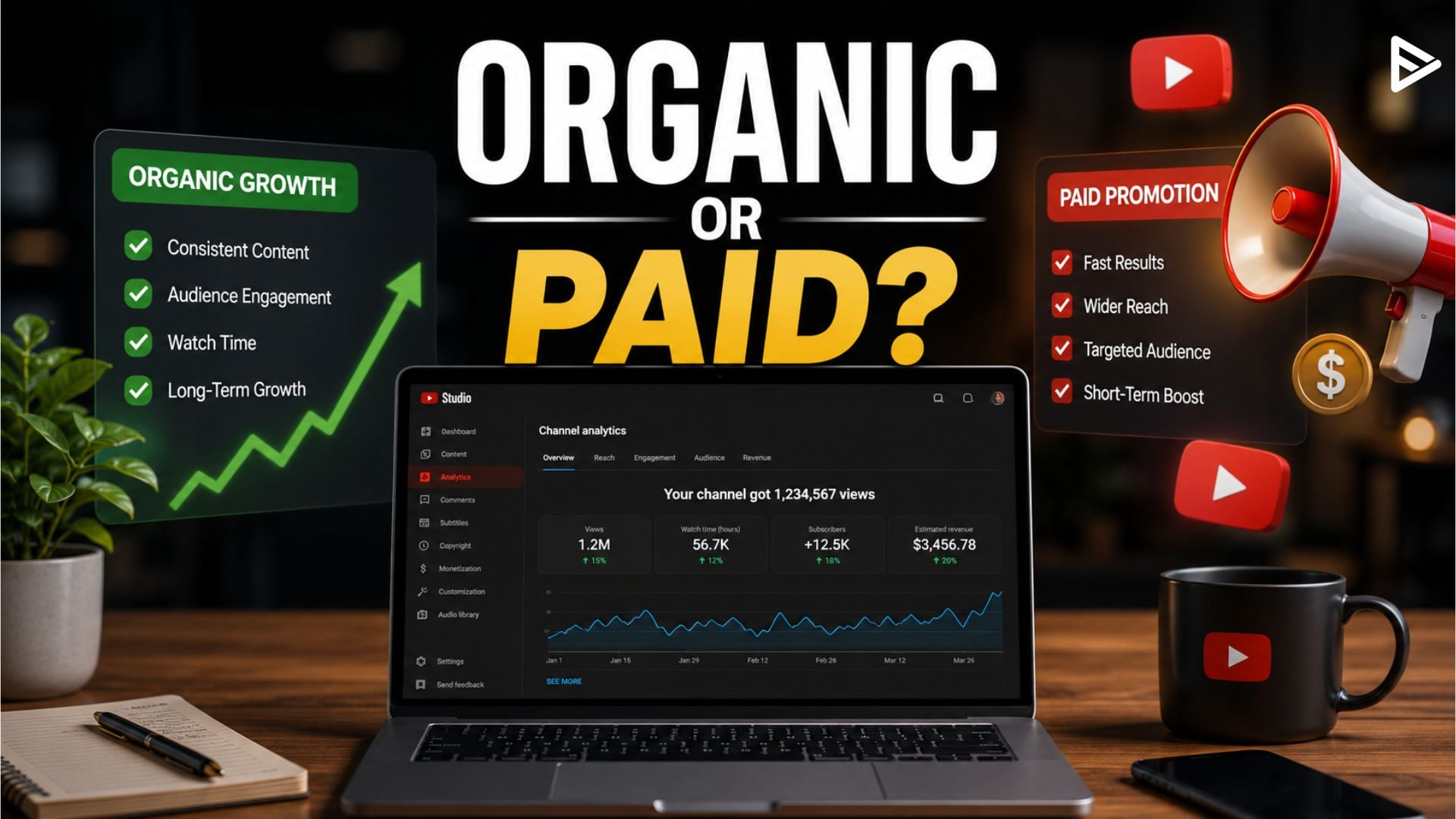
Key Takeaways:
- Organic YouTube growth helps build trust, keeps viewers coming back, and gives your content lasting visibility.
- Paid promotion can help you reach more people, but the quality of your content is what really determines your results.
- YouTube ranks videos by looking at watch time and how well you keep your audience, not just by counting views.
- Combining free and paid YouTube growth usually works better than relying on just one approach.
- Promoting a video at the right time can help it reach even more people if it is already doing well.
Many creators focus only on cost when comparing free and paid YouTube growth. But growing a channel is about more than just money. You need to attract the right viewers, keep them interested, and make content that YouTube is likely to recommend.
Free and paid YT growth: both channels, but in different ways. Knowing when to use each helps you grow your channel more effectively and achieve lasting results.
Understanding Organic and Paid YouTube Growth
Organic YouTube growth happens when people find your videos through search, recommendations, suggested videos, or by subscribing. You can achieve this by posting regularly, improving your content, and engaging with your audience.
Paid YouTube growth uses ads and promotions to get your videos in front of more people. This can quickly make your channel more visible and help you reach your target audience sooner. Both free and paid methods have their benefits. Organic growth helps you build trust and steady progress, while paid promotion lets people find you more quickly. The most successful creators use both together.
Free vs Paid YouTube Growth: Cost Comparison
| Free growth | Low | Slow | Building authority and consistency | Low |
| Paid growth | Medium to high | Fast | Boosting high-performing content | Medium |
| Hybrid approach | Controlled | Balanced | Scaling sustainable growth | Low to medium |
What Does YouTube’s Algorithm Actually Reward?
The YT algorithm highlights videos that keep viewers engaged and make them stay on your channel longer. Let us explore the parameters in depth:
- Watch Time: Videos with higher watch time are more likely to show up in recommendations and suggested feeds.
- Audience Retention: This shows that viewers find your videos interesting and engaging. It’s an important metric to support organic growth.
- Click-Through Rate: Before the viewer clicks the video, the title and thumbnail let them decide whether to watch.
Where Does Paid Promotion Actually Help?
Free growth helps you build a strong foundation, but it can take time to get noticed. That’s where paid promotion can help. If a video is already getting good engagement, even a small promotion can help it reach many more people. As more viewers find it, watch time increases, and YouTube is more likely to recommend it.
But promotion isn’t a quick fix. It works best to boost what’s already working. If your content doesn’t keep people interested, paid promotion won’t help for long.
Here’s a simple plan to grow your YouTube channel:
- Create content that keeps viewers watching.
- Identify videos with strong early performance.
- Use paid promotion to grow their reach.
This way, you can control your costs and still get better results.
Free vs Paid YouTube Growth: Pros and Cons
| Growth Method | Pros | Cons |
| Free YouTube Growth | Builds trust, long-term visibility, and loyal audiences | Requires patience and consistency |
| Paid YouTube Growth | Faster reach, audience targeting, quick visibility | Requires budget and ongoing optimization |
Best Strategy: Combining Organic and Paid Growth
The best way to grow your YouTube channel is to use both free and paid methods together. Begin by focusing on organic growth. Make valuable content, keep viewers watching, improve your titles and thumbnails, and find out what your audience likes. When a video is doing well, use paid promotion to help it reach more people. Rather than promoting every video, put your budget into content that has already shown it works.
Here’s a simple plan you can follow:
- Make content that keeps viewers watching.
- Look for videos that get good engagement early on.
-
Use paid promotion to help those videos reach more people.
-
Track how your videos perform and use what you learn to improve your next content.
With this approach, you do not have to choose between free and paid growth. Instead, you get a balanced strategy that uses both.
Final Thoughts
The detailed blog on free vs paid YouTube growth is all you need to refer to decide which is the best way forward for your YT channel. Free growth helps you connect more deeply with your audience, while paid growth helps you grow faster. If you rely solely on organic methods, your progress might be slow. If you rely solely on paid promotion, you might spend more without building a stable channel. The key is to use both approaches wisely. Start by making content that grabs attention. Once you see what works, put your resources into promoting those videos. This makes your growth more predictable.
Frequently Asked Questions
Q1.What is the main difference between free and paid YouTube growth?
Free YT growth happens when people find your videos through search and recommendations. Paid growth means using promotions to get your videos seen by more people.
Q2. Is organic YouTube growth still effective?
Yes, organic growth is still effective. It helps you build long-term engagement and aligns with YouTube’s video ranking.
Q3. Does paid promotion guarantee success?
No, paid promotion does not guarantee success. It can help you reach more people, but real engagement depends on the quality of your content.
Q4. When should you use paid YouTube growth?
After a video shows strong watch time and retention, paid promotion can help scale its performance.
