

WELCOME OFFER! Get 50% Extra Views On Your First Campaign with VeeFly. Use Promo Code - FIRST50 Get Started
Home » YouTube Marketing » YouTube Description Tips: How to Optimize for AEO in 2026

YouTube Description Tips: How to Optimize for AEO in 2026

AEO YouTube 2026 involves writing fact-dense descriptions for AI, leading with keywords, giving clear answers, and adding timestamps.

Key Takeaways:
  • AI search engines prioritize context and structured data over keyword stuffing.
  • In practice, this means directly answering the video’s core premise in the first two sentences of your description.
  • Additionally, since AI parses structured text, using clear points, short paragraphs, and distinct organization will make your content much easier for algorithms to extract.
  • As a result, effectively formatting your YouTube descriptions for AEO can increase the chances that your video will be embedded and cited in AI overviews, bypassing traditional rankings.
  • Focus on clearly defined, independent entities rather than just search queries; you help AI build a knowledge graph of your brand.

What Are YouTube Description Tips for AI Search?

YouTube description tips for AI search are specific formatting and copywriting strategies designed to help artificial intelligence models understand, summarize, and cite your video content. For example, use clear sentences stating your video’s main idea, include relevant entity names, and summarize key points in plain language. While traditional search relied on exact-match keywords, Answer Engine Optimization (AEO) focuses on entity relationships, natural language processing, and semantic clarity.

Why AI Search Is Changing YouTube Description Optimization

In the past, YouTube description SEO relied on repeating exact phrases. Today, AI models understand semantics. They do not just look for the word camera; they understand the entities surrounding it, like lens, aperture, and photography. If your text lacks contextual depth, the AI assumes your content lacks expertise.

When a user asks an AI assistant a question, the engine does not want to provide a list of ten blue links. It wants to synthesize a single, direct answer. AI engines actively seek out content that is already structured as a summary. If your description serves as a concise, clear abstract of your video, it becomes highly citable.

Conversational queries users are typing longer, more conversational questions into search bars. Instead of searching best microphone, they ask, “What is the best podcast microphone for a noisy room under $100?” To capture this traffic, your YouTube description optimization must directly address these hyper-specific, natural-language intents.

Top YouTube Description Tips for AI Search

To write quality video description best practices in the era of generative AI, you must restructure how you write. Here are the core tactics to implement on every upload.

Tip 1: Start with a Clear, Context-Rich Summary

The first two lines of your description are the most important for both search engines and AI systems. Do not waste this prime real estate saying “Welcome back to my channel.” Instead, immediately state the outcome. Provide a context-rich summary that clearly states the problem the video solves.

Tip 2: Match Search Intent Immediately

If your video is a tutorial, present a step-by-step guide from the start. Address the question early. For example, to explain how to fix a leaking sink, start with: “Here is the exact 3-step process to fix a leaking sink in under ten minutes.”

Tip 3: Use Natural Language (Not Keyword Stuffing)

Write for readability, prioritize natural language over stuffing keywords. Clear, specific wording signals high quality to natural language processing models. Avoid forcing supporting phrases unnaturally.

Tip 4: Include Related Keywords Contextually
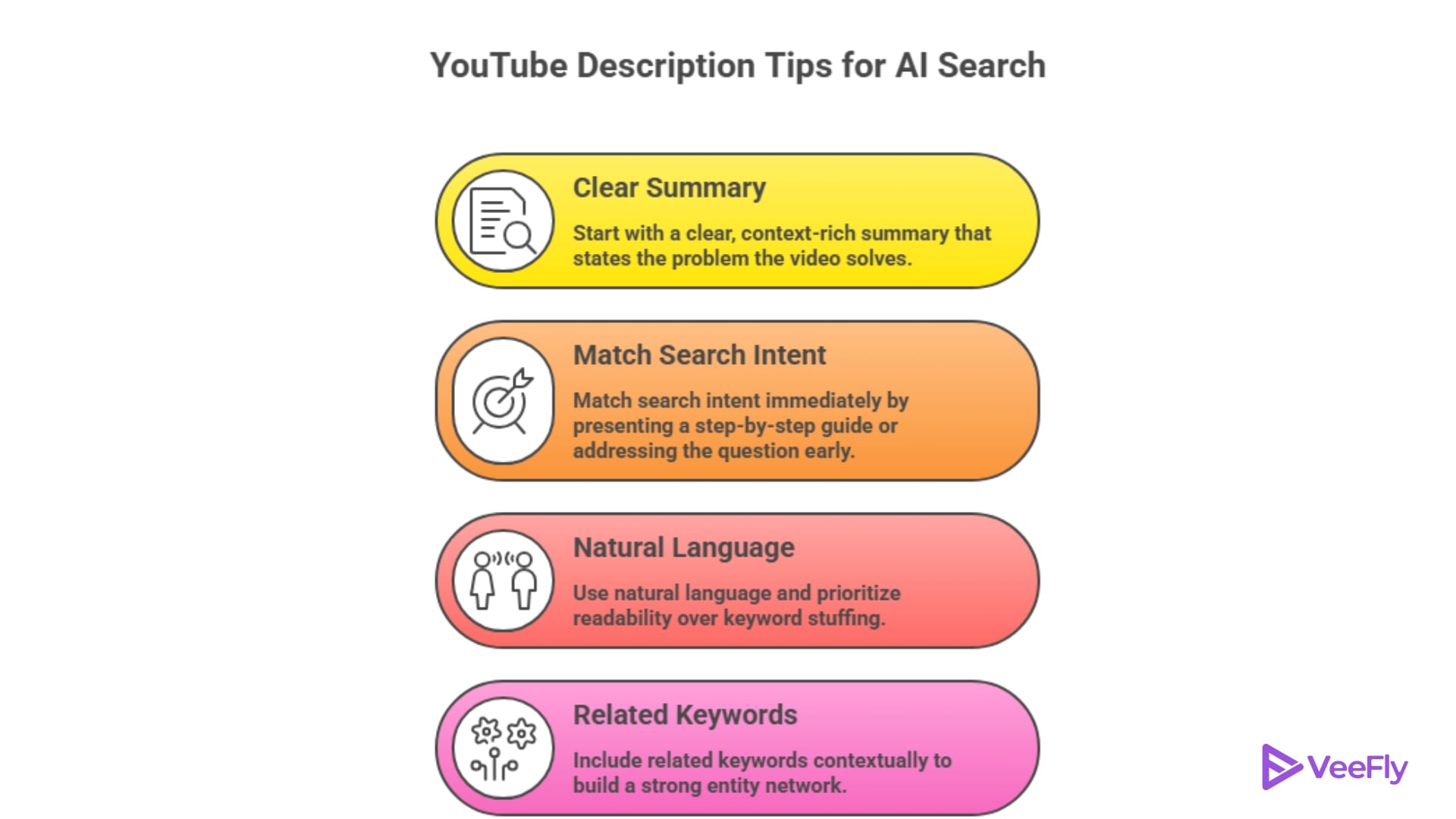
While keyword stuffing is dead, semantic relevance is critical. If you want to base a description on a desbased onion text, you must naturally include related industry terms. For example, when reviewing a laptop, naturally mention the processor, battery life, “RAM,” and “display refresh rate” to build a strong entity network.
youtube description tips for ai search in 2026

Tip 5: Structure Content for Readability

Break text into short paragraphs of 2 to 3 sentences for easier AI parsing. List items simply for clarity. Clear divisions help AI summarize your points more effectively in answer snippets.

Tip 6: Answer Questions in the Description

Explicitly ask and answer specific questions within your description to maximize extraction by AI. Present a question, such as “What is the best lens for portraits?”, followed by a direct, one-sentence answer.

Tip 7: Add Entities and Context Signals

Build trust signals for AI by including your credentials, naming specific tools, citing original data, and stating your brand. Mentioning clear entities demonstrates trustworthiness and authority.

Tip 8: Optimize for Featured Snippet Style Answers

When considering what to write in YouTube description boxes, aim for the YouTube featured snippet. Provide clear definitions, pros and cons lists, or numbered steps. The more cleanly you format the solution, the higher the probability that Google’s AI Overviews will pull your text verbatim.

Example of an AI-Optimized YouTube Description

The Weak Example (Outdated SEO):
  • Hey guys, welcome back! In this video, we discuss YouTube SEO tips. If you want to learn how to write YouTube descriptions and optimize YouTube description text, watch this! Don’t forget to like and subscribe. #youtube #seo #youtubeseotips #tips
  • Identify and avoid these errors: Wasting the first lines, unnatural keyword stuffing, lack of context, poor structure, and no extractable value for AI.
The Optimized Example (AEO/AI Search):
  • Learn exactly how to optimize your YouTube descriptions for AI search in 2026. This video breaks down the 3-step Answer Engine Optimization (AEO) framework to help your channel rank in AI Overviews and ChatGPT results.
  • What you will learn in this video: – How to write YouTube descriptions using the BLUF (Bottom Line Up Front) method. – The difference between semantic entities and traditional keyword stuffing. – How to format your text with bullet points to increase AI extraction rates.
  • By structuring your metadata for natural language processing, you dramatically improve your video’s contextual relevance and overall discoverability.
  • Apply these best practices: Deliver your value proposition first, use structured lists, write in natural language, and summarize clearly so AI systems can easily process and understand your content.

Final Thoughts

The definition of YouTube description SEO has changed permanently. We are no longer optimizing for a search bar that returns blue links; we are optimizing for intelligent answer engines that synthesize information. By applying these YouTube description tips for AI search, you transform your metadata from a digital afterthought into a highly citable, structured database.

Embrace the shift toward Answer Engine Optimization. Focus on clear context, structured readability, and direct answers. When you write descriptions that help AI understand and surface your content quickly and accurately, the algorithm rewards you with unparalleled reach and channel growth in 2026. Start optimizing your YouTube descriptions powered by AI today to see the difference for yourself.

Frequently Asked Questions

Q1. How do YouTube descriptions help AI search engines?

YouTube descriptions act as structured data for AI systems. They provide clear context about your video’s topic, intent, and key points. When written in natural language with summaries, bullet points, and direct answers, they help AI models extract and surface your content in search results, featured snippets, and AI-generated answers.

Q2. How long should a YouTube description be for AEO?

For AI search optimization, the ideal description length is 150–300 words of high-quality, structured content. Instead of maximizing character count, focus on clarity, keyword placement in the first two lines, and well-organized sections that AI can easily scan and interpret.

Q3. Do hashtags help YouTube descriptions rank in AI search?

Hashtags have limited impact on AI-driven search compared to structured text. While they can support discoverability within YouTube, AI systems rely more on semantic clarity, natural language, and contextual relevance in your description. Use hashtags sparingly and prioritize meaningful written content.

Q4. What tools can help write AI-optimized YouTube descriptions?

AI writing tools, keyword research platforms, and audience intent tools can help generate optimized descriptions. The best approach is combining AI-assisted drafting with manual refinement, ensuring your content includes clear summaries, question-based answers, and structured formatting aligned with search intent.

Q5. What format works best for AI-optimized YouTube descriptions?

The most effective format includes a clear summary (BLUF) in the first 2 lines and Bullet points of key insights or takeaways. Timestamps for easy navigation and Natural language answers to common questions. This structure improves readability for both users and AI systems, increasing your chances of being featured in AI search results.